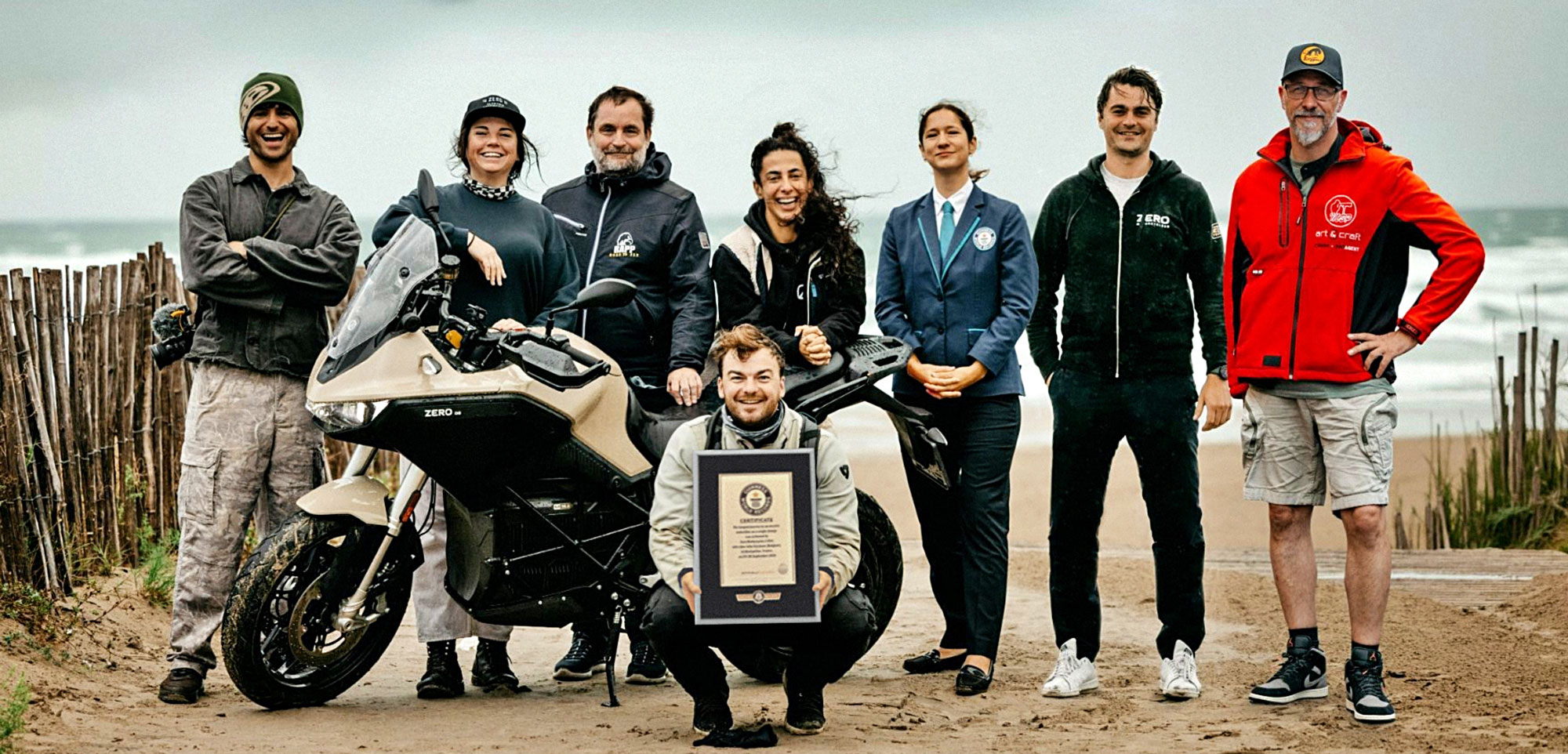
New Guinness World Record: Zero DS travels 436.5 km on a single battery charge
Electric Motors and Range: Few questions deter potential buyers from making a purchase for as long as this one. That’s exactly why it’s worth taking a look at an announcement Zero Motorcycles published on October 13, 2026: A production-model Zero DS traveled 436.5 kilometers on a single battery charge, setting a new Guinness World Record.
We’ll break down the number for you: What was measured, how was it calculated, and what does it mean for your daily life?
What exactly was achieved?
The trip took us from the French-Italian Alpine region to the Mediterranean coast, over mountain passes, along country roads, and through villages and towns. We didn’t use any highways. We set out in the evening around 7 p.m. from Les Claux near Vars, and made a brief stop in Arles along the way. The final leg through the Camargue was marred by a storm. The entire route was recorded via GPS and independently verified and confirmed by Guinness World Records. The previous record stood at 310.689 kilometers. The new record is 125.8 kilometers—or more than 40 percent—longer than that.
The rider was Jelle Verstaen, a Belgian motorcyclist and enthusiast, riding a Zero DS equipped with the optional, standard-issue Power Tank. This is an additional battery that increases the capacity from 15.6 to 19.2 kilowatt-hours. Otherwise, the motorcycle was stock: equipped with stock tires and the recommended tire pressure, without any technical modifications and without additional batteries.
Three riders, three production motorcycles
What’s exciting is that it didn’t stop at just one machine. Three riders started together, and all three broke the old record:
- Jelle Verstaen on the Zero DS with Power Tank: 436.5 kilometers.
- Jenny Brookes (Zero Motorcycles) on a stock DSR/X: 384 kilometers, including about 15 kilometers after the display had already shown “0%.”
- Louis Renaud, a Zero customer from France, with his own SR/S: 350 kilometers, finishing with a 4 percent remaining charge.
The fact that a regular customer rode along on his own motorcycle makes the statement more credible. It wasn’t a special vehicle that only works in a lab.
How was the record verified?
To ensure that the figure was more than just a claim, several precautions were taken: The charging port was sealed with tape before the trip, two certified GPS trackers were on board, a logbook recorded times, stops, and locations, and witnesses accompanied the trip. A Guinness adjudicator then reviewed the documentation for over an hour.
How was that range determined?
Here’s the part that’s actually useful for you. According to Zero, the route was designed for high energy efficiency, while still maintaining realistic conditions:
- Drive at a steady pace: Energy-intensive acceleration at traffic lights and intersections was avoided as much as possible.
- Using regenerative braking: On downhill stretches, the driver deliberately recovered energy and fed it back into the battery.
- Constant Speed: On open roads, maintaining a steady speed helped, as fuel consumption increases significantly with speed. The goal was to maintain a speed of around 52 km/h, as long as traffic and speed limits allowed. Small roads, driving during the evening and night hours when traffic was light, cruise control, and appropriate driving modes all contributed to this.
Added to this were the battery’s high energy density and low powertrain losses. The group drove the last 100 kilometers or so in pouring rain and strong crosswinds, so conditions were not ideal throughout the entire journey.
To be honest: Breaking records isn’t an everyday occurrence
Now for the part you’ve been waiting for. 436.5 kilometers isn’t a real-world range you can expect every day, regardless of the weather or your speed. The record was set using the Power Tank, on a route specifically designed for efficiency, and with a deliberately economical riding style. The official factory specification for the Zero DS is up to 249 kilometers in city traffic (with the standard 15.6 kWh battery). You should base your purchase decision on this figure, not on the record-breaking number.
What the record does show, however, is that an electric motorcycle often has more to offer than the spec sheet suggests if you ride with foresight. If you keep your speed, acceleration, and regenerative braking under control, you’ll get noticeably more out of every charge. This generally applies to your commute as well, whether you’re riding a motorcycle or an e-scooter. We’ll show you how to realistically estimate your route in our range check for your commute.
Who is the Zero DS for?
The Zero DS is an accessible dual-sport motorcycle that, according to Zero, is suitable for an A1 driver’s license. It’s the lighter sibling of the DSR/X and combines everyday practicality with Z-Force drive technology. We’d be happy to help you determine which license class is right for you during a consultation. You can find an initial overview in our article “45 km/h or 125cc? Which e-scooter matches your license.”
Conclusion: Range Depends on Technology and Driving Style
Zero will celebrate its 20th anniversary in 2026, and with this record, it’s sending a clear message: range anxiety—which keeps many people from riding electric motorcycles—has become less of a concern. And because the record was set using production bikes and a regular customer, it demonstrates what the technology is capable of today.
Still, the fact remains: Numbers are good, but the real riding experience is better. Stop by our location in Regensdorf or Bern, check out the Zero models, and talk to us about your route. We’ll give you an honest breakdown of what you can expect in everyday use.
Until then: Have a safe ride! 🛵

