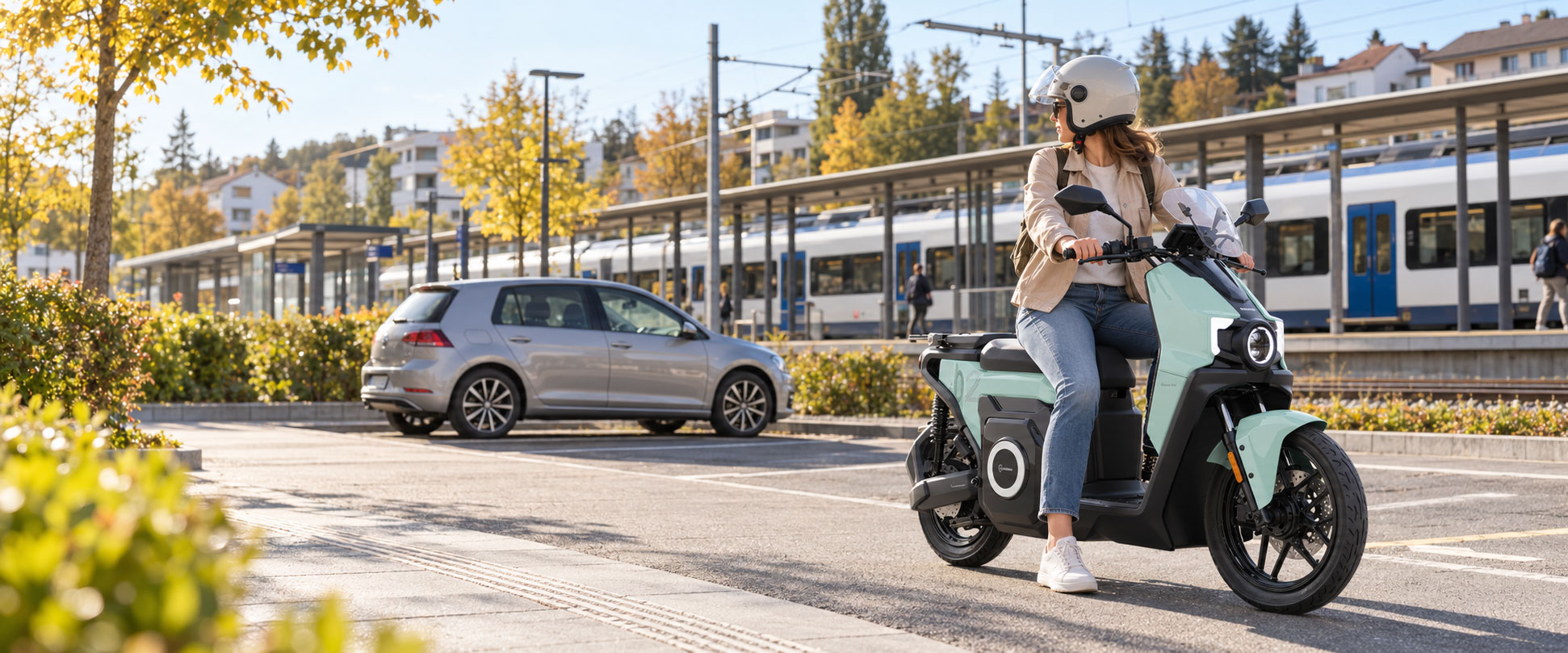
E-Scooter vs. GA vs. Car: How Much Does Your Commute Really Cost?
At some point, every commuter reaches the point where they start doing the math. The GA has gotten more expensive again, the second car sits idle most of the time but still costs money—and what about the e-scooter? It sounds cheap, but how much does it really save?
Instead of relying on marketing claims, we’re doing the math honestly here, using official figures from SBB, TCS, and the Federal Electricity Commission. And we’ll also point out where the e-scooter falls short.
The starting point: a typical Swiss commute
The average commute in Switzerland is 13.7 kilometers. Round trip, over about 220 workdays, that adds up to roughly 6,000 kilometers per year just for commuting. We’ll use this distance to compare the three options.
Option 1: The GA
A 2nd-class General Subscription currently costs CHF 3,995.– per year; starting with the timetable change in December 2026, it will cost CHF 4,095.–. In return, you get something that neither a car nor a scooter can offer: unlimited travel throughout Switzerland, even on weekends and during holidays.
To be honest: If you use the GA pass extensively in your personal life, you get a lot of value for your money. But if you buy it mainly for your commute to work, you’re often paying for services you don’t need. And for a commute-only route, there are often more affordable options, such as regional or route-based passes—prices depend on your region.
Option 2: The (Second) Car
The TCS estimates that by 2026, the cost for a typical car will be 74 rappen per kilometer — that’s about CHF 11,100 per year based on average mileage. The key point lies in the details: Of that amount, just under CHF 7,000 consists of fixed costs— depreciation, insurance, taxes, and garage fees. These costs are incurred even when the car isn’t being driven.
That’s exactly what makes a second car for commuting so expensive: You pay most of the cost before you’ve even driven a single kilometer. And that doesn’t even include parking fees in the city or the time lost in traffic jams.
Option 3: The E-Scooter
Now it gets interesting, because the running costs for e-scooters are surprisingly low. For example, a popular model like the Silence S01 has a 5.6 kWh battery. A full charge costs about CHF 1.55 based on the average Swiss electricity price of 27.7 rappen per kWh.
If we make a generous estimate accounting for winter driving conditions and charging losses , your annual electricity cost for a 6,000-kilometer commute will be about CHF 100. For comparison: That’s less than a single month’s GA pass.
In addition:
- Purchase: E-scooters for daily commuting cost roughly CHF 2,500 to 9,000. Spread out over their useful life—for example, CHF 6,000 over six years—that comes to about CHF 1,000 per year.
- Insurance and taxes: Vary by canton and model. In the canton of Zurich, for example, e-scooters are exempt from motor vehicle tax.
- Service: Electric motors have fewer wear-and-tear parts than gasoline engines—no oil changes, no exhaust system. Maintenance is correspondingly minimal.
The Comparison at a Glance
| Second-Class GA | Second car | E-scooter | |
|---|---|---|---|
| Annual costs | CHF 3,995 (as of Dec. 2026: 4,095) | Approx. CHF 11,100, of which approx. 7,000 is fixed | Electricity: approx. CHF 100 + purchase costs (e.g., approx. 1,000) + insurance/taxes |
| Fixed Costs Even Without Driving | Yes (Subscription) | high | deep |
| Parking in the city | — | often expensive | usually simple |
| All of Switzerland, including | ✅ | ✅ | ❌ (City & Region) |
Figures: SBB, TCS, ElCom (as of 2026). E-scooter figures are used as examples for insurance and tax calculations, which vary by canton and model.
Where the E-Scooter Doesn’t Win
Let’s be honest: An e-scooter isn’t a substitute for every trip. It’s not designed for vacations in Ticino, big shopping trips with the family, or a day in the snow. And when the roads are icy, you’d rather take the train anyway.
That’s why many commuters are best off using a combination: e-scooters for everyday travel and around town, plus a Half-Fare Card or individual discount tickets for long distances. That way, you only pay for what you actually use.
Conclusion: The biggest factor is the second car
Compared to a second car, an e-scooter can quickly save you several thousand francs a year, mainly because there are no high fixed costs. Compared to a GA travelcard, it depends on how much you travel by train for personal reasons: If you mainly commute, an e-scooter combined with a Halbtax pass is usually the more affordable option.
The exact calculation is as unique as your commute. It’s best to run the numbers yourself using your own figures, or let’s go over them together—either at our office in Regensdorf or in Bern.
Until then: Have a safe ride! 🛵

