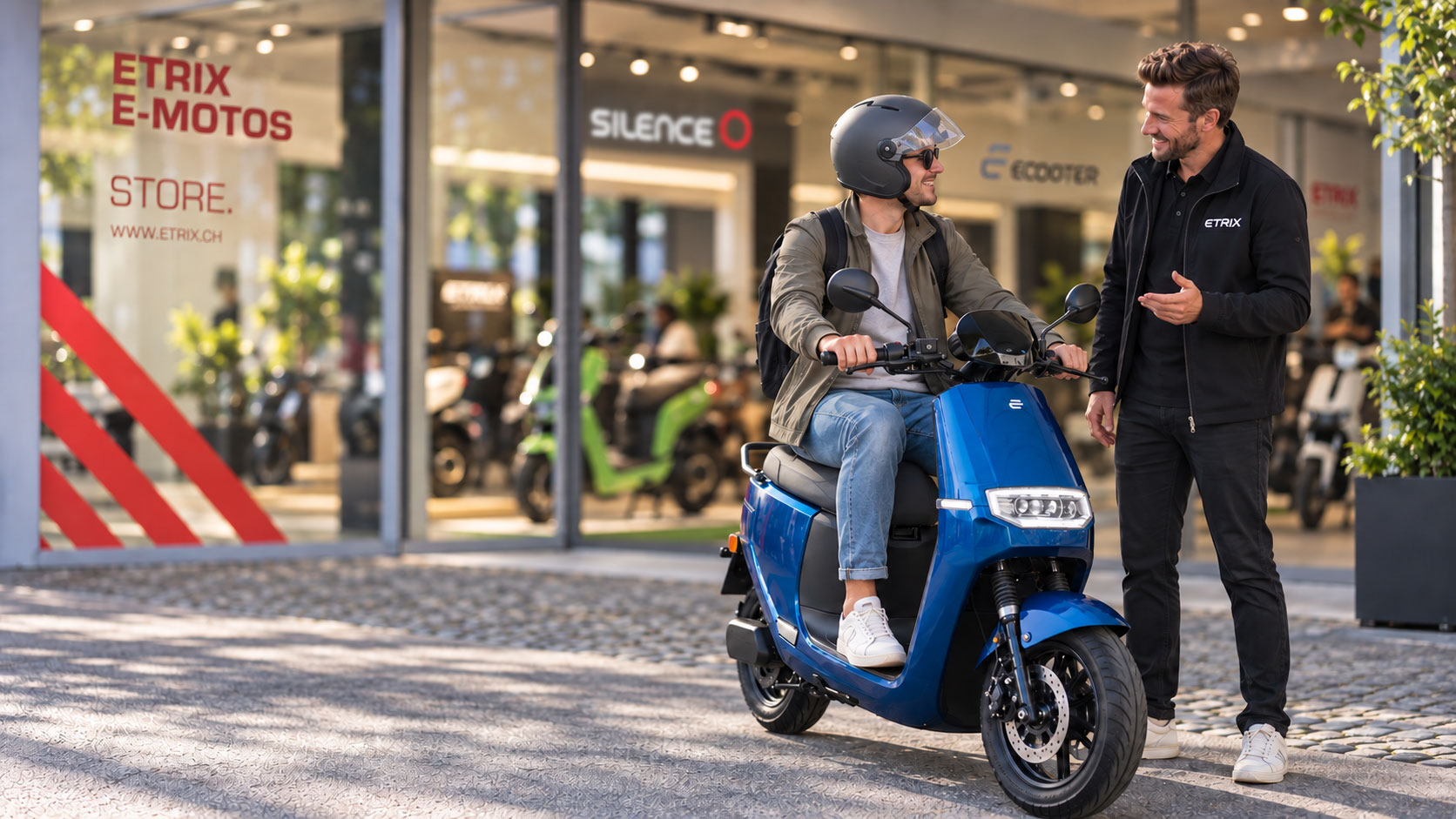
E-Scooter Test Ride: 7 Things You Need to Know Beforehand
You’ve done your research, compared models, and probably read one too many spec sheets—and yet one question remains: Does this car really drive as well as it looks? That’s exactly what a test drive is for.
But a test drive is only as good as your preparation. If you’re just zipping around the block, you’ll end up making a decision based on gut feeling anyway. And since an e-scooter is a purchase you’ll have for years, it’s worth making the most of your test ride—instead of just going through the motions. With this honest checklist, you’ll get more out of the appointment and make a decision afterward that you won’t regret. Seven key points to consider.
1. Is this seating position really right for you?
First impressions are formed while you’re standing still. Sit on it before you ride off: Can you reach the ground securely with both feet? Are you sitting upright and relaxed, or do you have to stretch your legs uncomfortably? An e-scooter that makes you feel uncomfortable even at a traffic light won’t get any better on your commute. Pay attention to the seat height, knee angle, and how well the handlebar width suits you. This makes all the difference, especially for shorter or taller riders.
2. How do acceleration and braking feel?
This is where the driving experience differs from the spec sheet. Apply the gas evenly when pulling away: Does the acceleration kick in jerkily, or is it smooth and controllable? For city driving, you want a predictable feel—no jerky movements when pulling away from a stoplight, but enough power to keep up with the flow of traffic with ease. If your route includes hills, make a point of finding a small incline for your test drive: going uphill quickly reveals whether the car has enough power for everyday use. Just as important: braking. Feel free to test a harder braking maneuver (while keeping an eye on the road behind you, of course). Do the brakes respond smoothly and controllably, or do they lock up too abruptly? A confident braking feel gives you more peace of mind in everyday driving than any horsepower argument ever could.
3. How easy is it to maneuver the scooter when it’s stationary?
You’re actually riding it only part of the time—the rest of the time, you’re pushing, parking, and maneuvering it. Try taking the scooter off its stand, pushing it a few meters, and putting it back down. How heavy does it feel when you maneuver it backward out of a tight parking spot? Anyone who parks in the city without their own garage quickly realizes that a manageable weight is more valuable in everyday life than those last few kilometers of range on paper.
4. Range: Ask for real-world figures
You can’t reliably test the range on a short test drive—the route is too short for that—and a fully charged battery on a single day doesn’t say much about real-world use. But here’s what you can do: ask specific questions. Manufacturer specifications are lab figures and are noticeably lower in real-world conditions, such as cold weather, hills, and cargo. Ask a sales consultant for realistic estimates based on your driving profile, and be sure to factor in a reserve—especially for winter—rather than optimizing exactly for your daily commute. We’ve explained step by step how to estimate your actual needs in our range check guide.
5. Replacement battery: Take it out yourself once
For anyone without their own garage, the removable battery is often the key factor that makes an e-scooter practical for everyday use—you can charge it at a standard outlet in your apartment. But here’s the thing: you have to actually want to do it. During your test ride, try removing the battery yourself and putting it back in. How easy is it to remove? How heavy is it? Can you comfortably carry it up to the third floor? What sounds elegant on paper comes down to practical considerations here.
6. Accessories and Storage Space: Does It Fit Your Daily Life?
Your commute involves carrying things—a laptop bag, groceries, a helmet. Check what fits under the seat and whether you can add a top case later. Is there enough storage space for your helmet when you park? Can you stow a second helmet for a passenger? Little details like these hardly stand out in the brochure, but in everyday life, they determine whether the scooter really fits into your life.
7. The Right Questions to Ask During a Consultation
A test ride is also a chance to ask questions—make the most of it. Here are some good questions to ask: What’s the situation with service and replacement parts if something goes wrong? What kind of driver’s license do you need for this model? What are the realistic running costs? One advantage of shopping with us: You can compare multiple brands—such as Silence, Ecooter, Felo, or Zero—all in one place, instead of driving from dealer to dealer. That way, you can feel the differences right away, not just weeks later.
Conclusion: Driving beats reading
Spec sheets are helpful, but they’re no substitute for the driving experience. If you keep these seven points in mind—such as seating position, acceleration and braking, handling, and range—and honestly evaluate them, test the replacement battery yourself, check the storage space, and ask the right questions, you’ll go into your appointment prepared and make your decision based on logic rather than gut feeling.
The best thing to do is just try it out for yourself—here in Regensdorf or Bern. ✅
Until then: Have a safe ride! 🛵
→ Experience the range firsthand—book a test drive now

